The question
It is a free evening, and for once nothing is waiting for you. The work is done, or done enough, and you have opened a novel you have been meaning to read since the spring. A few paragraphs in, your hand finds the phone. A friend from your old job has been promoted. Someone you were at school with has run a marathon, and there is a photograph of him at the finish, wrapped in foil like a baked potato and very pleased about it.
Nothing in the room has changed. The lamp is as warm as it was and the novel is open at the same page. Yet the evening now feels like ground you are losing, and an hour that was rest a moment ago seems to need an excuse.
Why should a quiet evening, which costs nobody anything, feel so much like falling behind?
The film answers in a few minutes. Here the same answer is taken more slowly, with the full passage from Seneca in his Latin and the research behind the film, a theory and two sets of studies, each with what it can and cannot show.
The argument
Nothing to count
A working day has its measures: the emails answered, the shift handed over, a list with lines through it. An evening with a novel produces no total. It leaves nothing behind to add up, and so nothing to show that it went well.
A borrowed ruler
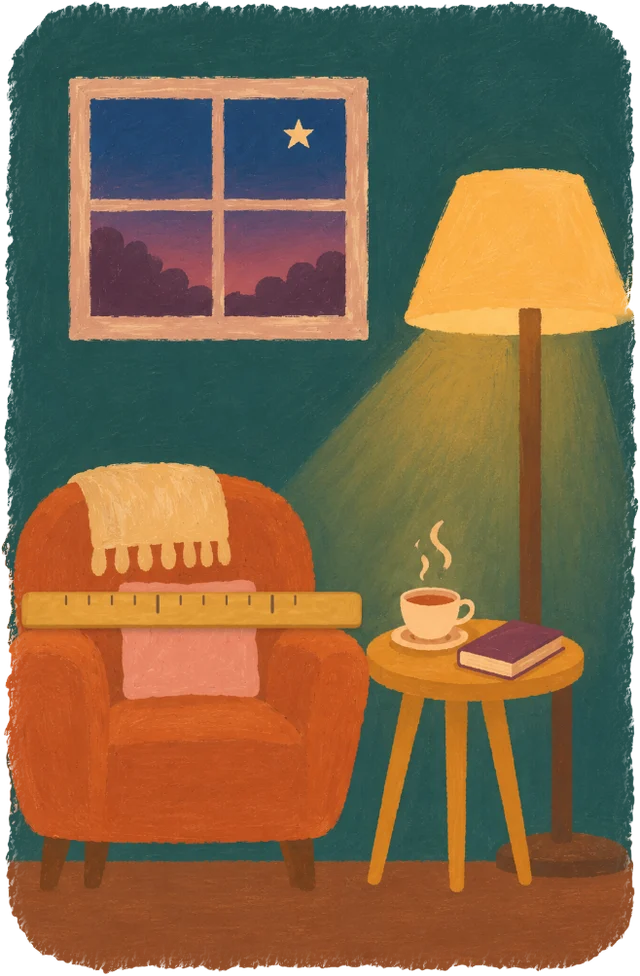
In 1954 the social psychologist Leon Festinger proposed a theory of how people judge themselves when there is nothing fixed to judge by. His second hypothesis reads: “To the extent that objective, non-social means are not available, people evaluate their opinions and abilities by comparison respectively with the opinions and abilities of others.” His third adds that the more someone differs from us, the less we compare ourselves with them. So the measure we borrow tends to come from people near to us: the friend from the old job far more than a stranger on another continent.
That is what the phone brings in. It hands you a ruler, and you lay it across your evening without quite deciding to. Festinger wrote about opinions and abilities; carrying his theory into a free evening is our step, and the film’s.
Marked in other people’s best days
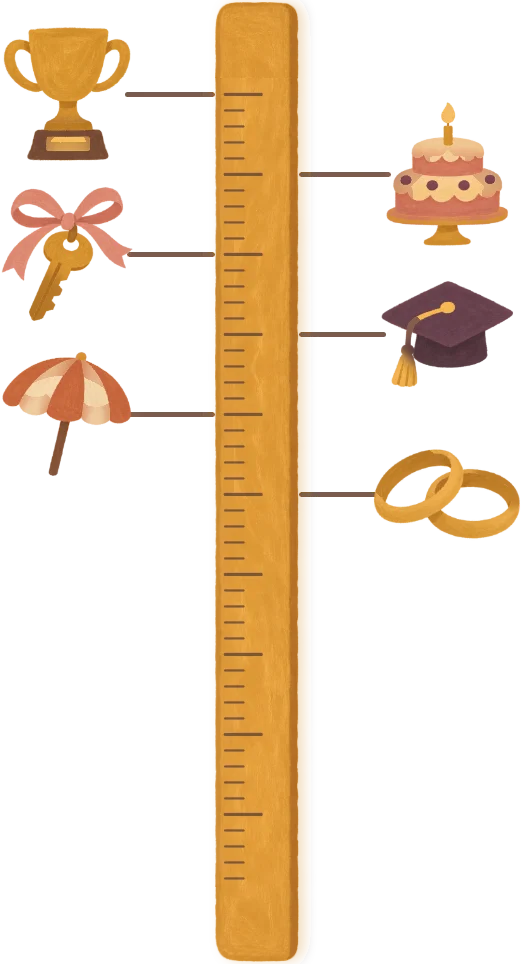
The ruler has a fault in its markings. In 2011 Alexander Jordan, Benoît Monin, Carol Dweck and three colleagues published four studies under the title “Misery has more company than people think”. Students reported their negative emotions as more hidden than their positive ones, and their peers underestimated how common those hard feelings were while overestimating the good ones. In one study, students believed their peers went out with friends and to parties more than those peers actually did.
Other people’s good days reach us easily, a promotion or a finish line, while their hard evenings mostly stay at home with them. The ruler ends up marked in everyone else’s best moments. Held against a scale like that, an ordinary Tuesday will always come up short, and so would anyone’s.
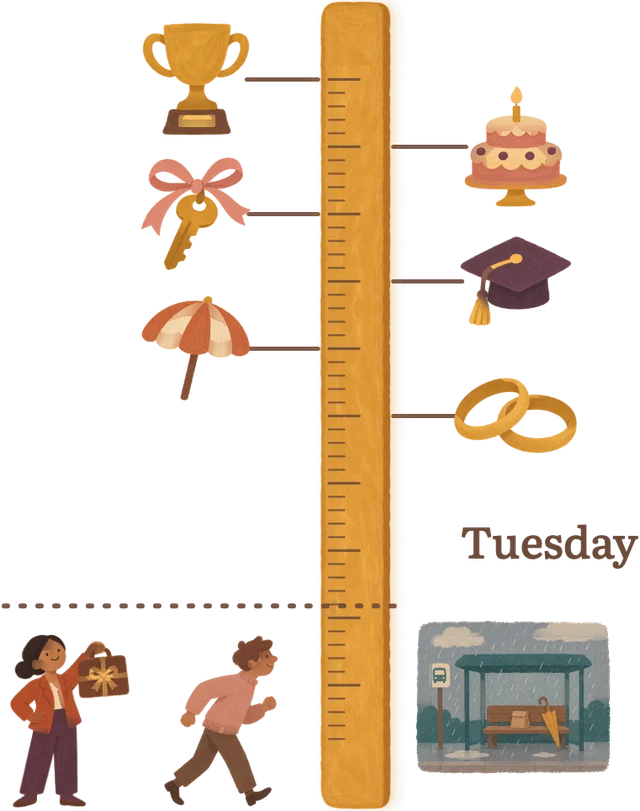
The study found one more thing. Students who underestimated others’ hard experiences most tended to be lonelier, to brood more and to be less satisfied with their lives. That is a correlation, so it cannot say which way the influence runs.
What the measuring costs
The measuring has a second cost, and it falls on the evening itself. In 2021 Gabriela Tonietto, Selin Malkoc, Rebecca Walker Reczek and Michael Norton published four studies with 1,310 people under the title “Viewing leisure as wasteful undermines enjoyment”. People who agreed that leisure is wasteful enjoyed it less, most of all the things they did purely for their own sake.
In their third study, 458 students read a mock New York Times article that called leisure wasteful, or unproductive, or productive, or said nothing about it. Then they all watched the same funny cat video. The students told that leisure was unproductive enjoyed the video less than those told nothing. The students told that leisure was productive enjoyed it no more. In a fourth study, an article that described waste in kindly terms still lowered enjoyment.
So the usual way out, making the evening useful and calling rest fuel for tomorrow, does not seem to bring the enjoyment back. The novel is read with half an eye on the ruler, the tea goes cold, and the worry about losing the evening ends up taking the evening away.
“But I really am behind”
You might fairly answer that you are, in fact, behind. Some people really are further on, and one evening with a novel will not close the gap. Goals matter, and nothing here asks you to give yours up.
Festinger’s fourth hypothesis speaks to this. “There is a unidirectional drive upward in the case of abilities”, he wrote, and the drive rests only when a person is a little ahead of those around them. Then he drew the consequence: “It is obvious that not everyone in a group can be slightly better than everyone else. The implication is that, with respect to the evaluation of abilities, a state of social quiescence is never reached.” Catch up with the friend from the old job and the ruler lengthens to the next person along. It was never made to tell you when you may stop.
Festinger himself allowed that the upward drive may belong to a culture: “In Western culture, at any rate, there is a value set on doing better and better”.
Seneca’s letter
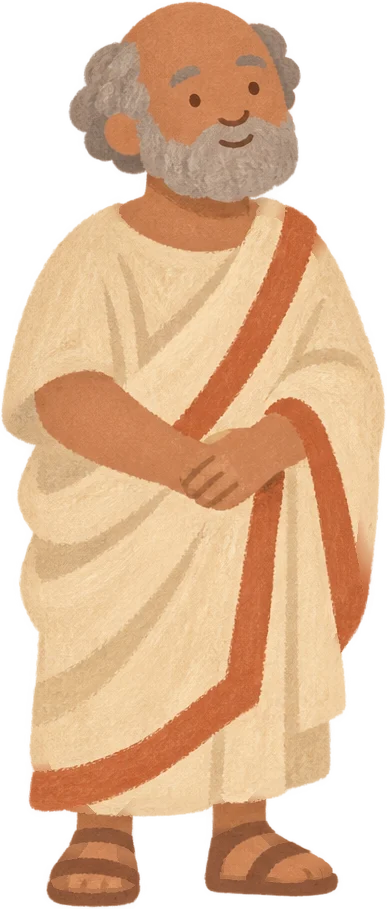
Seneca lived in Rome in the first century AD, and among his works are letters of advice to his friend Lucilius. The third is about friendship: whether to trust everyone or no one. Seneca answers that both are faults, and in the letter’s last lines he finds the same pair of faults in the way people work and rest. Here is the whole passage, sections 5 and 6.
5 Sic utrosque reprehendas, et eos qui semper inquieti sunt, et eos qui semper quiescunt. Nam illa tumultu gaudens non est industria sed exagitatae mentis concursatio, et haec non est quies quae motum omnem molestiam iudicat, sed dissolutio et languor.
6 Itaque hoc quod apud Pomponium legi animo mandabitur: ‘quidam adeo in latebras refugerunt ut putent in turbido esse quidquid in luce est’. Inter se ista miscenda sunt: et quiescenti agendum et agenti quiescendum est. Cum rerum natura delibera: illa dicet tibi et diem fecisse se et noctem. Vale.
5 In like manner you should rebuke these two kinds of men, both those who always lack repose, and those who are always in repose. For love of bustle is not industry, it is only the restlessness of a hunted mind. And true repose does not consist in condemning all motion as merely vexation; that kind of repose is slackness and inertia.
6 Therefore, you should note the following saying, taken from my reading in Pomponius: “Some men shrink into dark corners, to such a degree that they see darkly by day.” No, men should combine these tendencies, and he who reposes should act and he who acts should take repose. Discuss the problem with Nature; she will tell you that she has created both day and night. Farewell.
Seneca blames both extremes. Rest that treats every movement as a nuisance is, in Gummere’s words, “slackness and inertia”. His advice is a balance, and his evidence for it is the plainest thing he could point to: nature made both day and night.
He was no champion of lounging. In On the Shortness of Life he says that the only people truly at leisure are those who give their time to philosophy,2 and his first letter to Lucilius warns that “the largest portion of our life passes while we are doing ill, a goodly share while we are doing nothing”. Gummere softens the Latin there: maxima means the greatest part. The film takes from Seneca only his balance.
Day and night
Nobody looks out of the window at nine o’clock and decides that the sun has fallen behind, or that the night is a day that failed to get anything done. The dark is the other half of the same day, and the day needs it. Your evening belongs to that half, and it was never on your friend’s ruler at all.
This is where the film and this article go beyond Seneca. He wrote of rest and action combined across a life, to a friend, nearly two thousand years before anyone carried a phone. Reading a free evening as the night half of the day is ours.
The research, and its limits
Festinger, 1954
A theory
- What it is
- A theory paper with hypotheses and derivations, drawing on small group experiments. Foundational, and widely built on since.3
- What it proposes
- Without an objective measure, people judge their opinions and abilities by comparing with others, mostly others like them. For abilities there is a drive upward, and since not everyone can be slightly ahead, the comparing never settles.
- Limits
- It is a proposal, so the article says “proposed”. It concerns opinions and abilities. Festinger thought the upward drive might be Western. Applying it to an evening is ours.
Jordan and colleagues, 2011
Four studies, US students
- What they did
- Studies of 63 and 80 first-year students, of 214 first-years and their peers, and of 104 students, comparing what people felt with what their peers believed they felt.4
- What they found
- Negative emotions were more often hidden; peers underestimated how common they were and overestimated positive ones. Lower estimates of others’ hard experiences went with more loneliness and brooding and lower life satisfaction.
- Limits
- Small samples of US students, gathered before most social media. The link with loneliness is a correlation. “Difficult evenings” is our everyday gloss on “negative experiences”.
Tonietto and colleagues, 2021
Four studies, 1,310 people
- What they did
- 302 online adults recalling Halloween; 199 undergraduates, preregistered; 458 students reading one of four mock articles before a cat video, preregistered; 351 undergraduates given a kindly framed “wasteful” article. The data are open.5
- What they found
- Believing leisure is wasteful went with enjoying it less, above all leisure done for its own sake. Calling leisure unproductive lowered enjoyment of the video (d = 0.30, p = .026); calling it productive made no difference (d = 0.03). The kindly framed article still lowered enjoyment (d = 0.26).
- Limits
- The effects are small, about a quarter of a standard deviation. In the third study the “wasteful” article’s gap from the control fell just short of the usual threshold (p = .053); the fourth study found it again. The participants were students and online adults, the task was a few minutes of video, and the links with happiness, depression, anxiety and stress are correlations. No independent replication had been found when the film was researched.